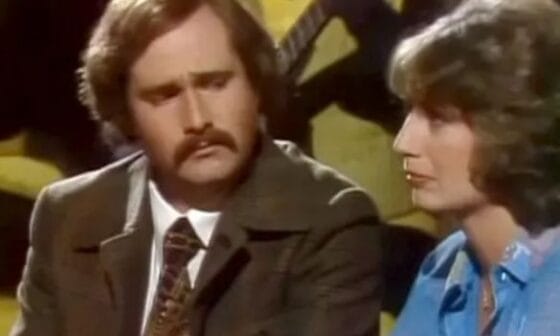
The instant Tim Conway snapped, “Sir, I’m the one asking the questions here!”, the sketch quietly crossed a point of no return. What had been designed as a sharp, disciplined spy parody suddenly became something far more dangerous: a live experiment in how long trained professionals could survive Conway’s calm, calculated absurdity. There was no warning, no buildup — just a single line delivered with authority that immediately tilted the room off balance.
Conway’s genius was never about volume or exaggeration. Instead, he weaponized restraint. He stood firm, expression steady, letting the silence linger just long enough to feel wrong. Those pauses became unbearable, stretching the tension until the audience could sense something slipping loose beneath the surface.
As Conway’s detective slowly unraveled, Harvey Korman became the audience’s proxy. You could see him fighting for control, clinging to the script and his training. Every subtle movement from Conway — a twitch, a delayed response, a glance held too long — chipped away at Harvey’s composure.
The sketch transformed into a visible struggle. It wasn’t just character versus character anymore; it was discipline versus inevitability. The laughter building in the room wasn’t triggered by jokes, but by anticipation — the shared knowledge that Harvey was losing ground.
Then came the truth serum. Conway’s delivery, slurred and nonsensical, wasn’t loud or theatrical. It was disturbingly calm. Each mangled word landed like a small crack in the dam, and the audience felt the pressure rising with every syllable.
Harvey’s resistance finally collapsed. When he broke, it wasn’t a gentle crack — it was total surrender. His laughter exploded, uncontrollable and contagious, threatening to derail the entire production. Even the camera struggled to keep up, shaking as if caught off guard by the magnitude of the moment.
What made the scene unforgettable was its authenticity. Nothing felt forced or rehearsed. The laughter wasn’t planned. The breakdown wasn’t scripted. It was a real-time implosion, captured live, impossible to recreate.
Carol Burnett’s world thrived on moments like this — when comedy stopped pretending to be polished and revealed its raw core. Conway didn’t overpower the sketch; he dismantled it quietly, piece by piece, until laughter was the only thing left standing.
This wasn’t comedy built on punchlines. It was built on trust, timing, and the courage to let silence do the work. Conway understood that the smallest disruption, delivered with confidence, could produce the loudest response.
Decades later, the moment still resonates because it shows comedy at its purest. Not scripted perfection, but controlled chaos. A reminder that sometimes the funniest thing isn’t what’s said — it’s what happens when everything falls apart, and no one can stop it.