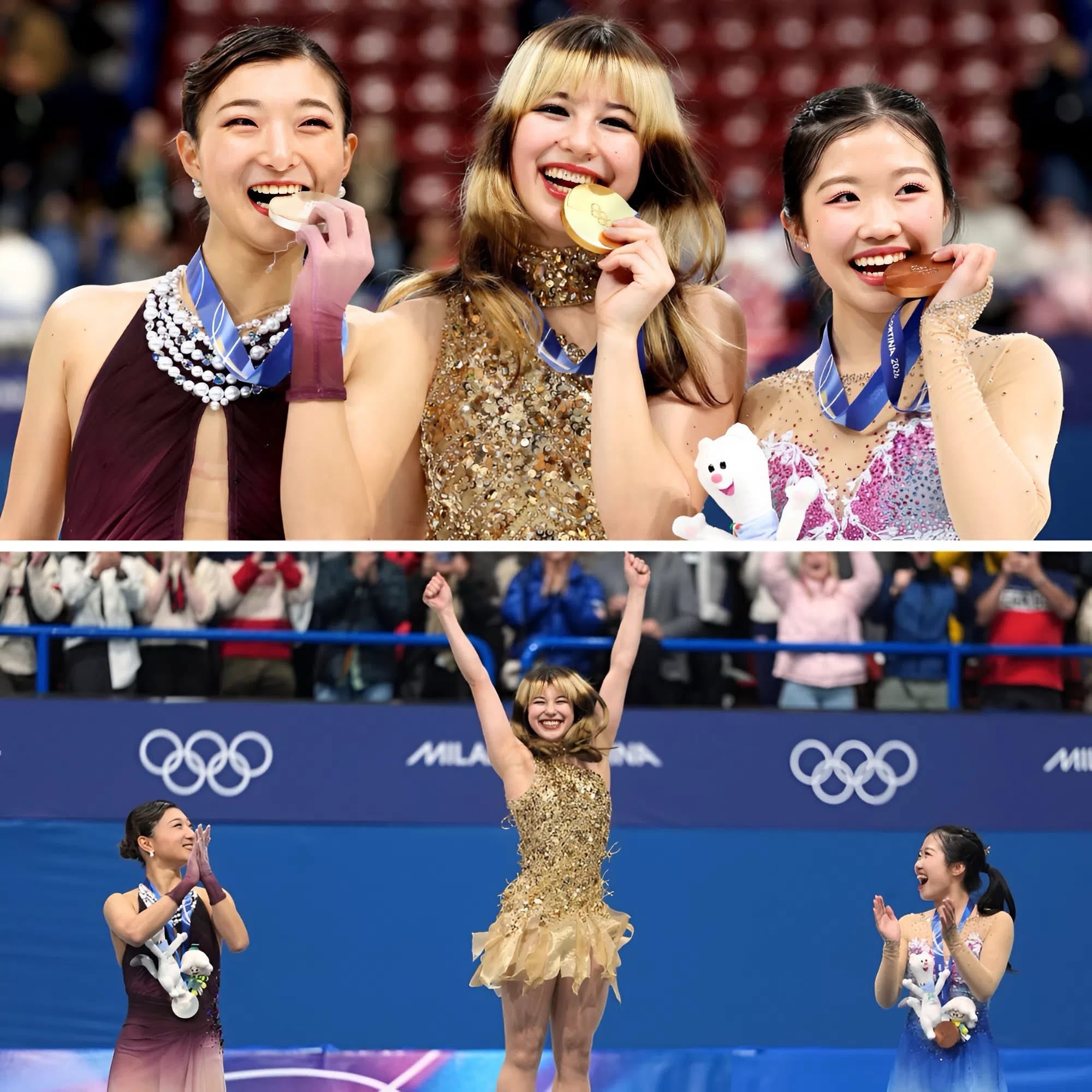
Alysa Liu didn’t just win gold at the 2026 Winter Olympics — she rewrote her own story in the process. Entering the free skate in third place, the 20-year-old delivered a performance that felt both fearless and inevitable, surging to the top of the podium and ending a 24-year drought for U.S. women’s singles skating.
From the opening seconds, there was a different energy about her. The Triple Lutz exploded off the ice — high, tight, and unmistakably clean. The Triple Salchow followed with effortless precision. Each landing was punctuated not just with technical clarity, but with a calm confidence that suggested she wasn’t chasing the moment — she owned it.
By the time she reached her final pose, the arena in Milan was already rising. When the score confirmed it, the roar felt seismic. 226.79. Gold. History. And a statement that echoed far beyond one competition.
But what makes this victory resonate even more deeply is the decision Liu made years ago — the one that shocked the skating world. At just 16, she stepped away from the sport entirely. Burned out. Overwhelmed. Uncertain whether she even loved skating anymore. Many believed that walking away at the height of her early success would permanently derail her Olympic dreams.
Instead, that pause became the turning point.
Away from the relentless expectations and spotlight, Liu rediscovered something she had lost: joy. When she eventually returned to training, it wasn’t fueled by pressure or legacy. It was personal. She came back not to prove critics wrong — but to feel free again on the ice.
That shift in mindset changed everything. The skater who arrived in Milan wasn’t the prodigy carrying the weight of a nation. She was an athlete grounded in her own purpose, skating with clarity instead of obligation. The difference showed in every edge and every landing.
From doubt to dominance. From “what if” to “what now.” Her comeback wasn’t built on defiance — it was built on self-awareness. And that may be what makes this gold medal feel so powerful.
In a sport often defined by early peaks and fleeting windows, Alysa Liu proved that stepping away doesn’t always mean stepping back. Sometimes, it’s the very move that allows an athlete to return stronger than ever.
And as she stood atop the podium — composed, smiling, soaking in a moment years in the making — it was clear this wasn’t just a victory over the field. It was a victory over fear, burnout, and expectation.
Gold wasn’t the end of her story. It was the proof that rewriting it was always possible.