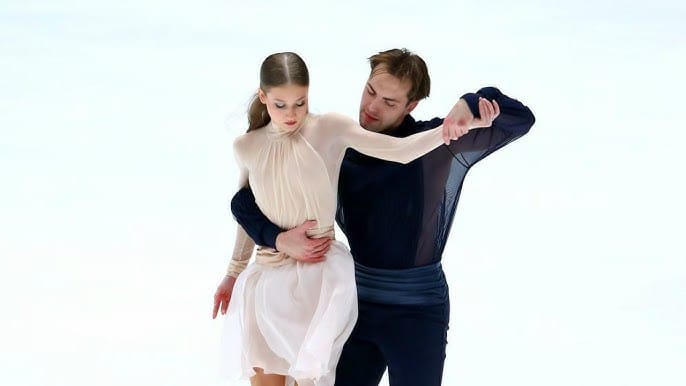
There are performances that impress with precision, and then there are performances that stay with you because they feel almost too real to watch. When Vasilisa Kaganovskaia and Maxim Nekrasov took the ice to Rain In Your Black Eyes, it didn’t feel like a routine unfolding—it felt like something fragile slowly breaking apart in front of everyone.
From the very first notes of Rain In Your Black Eyes by Ezio Bosso, there was a quiet tension in the air. Their movements weren’t grand or overpowering—instead, they felt restrained, almost hesitant, like two people trying to hold onto something that was already slipping through their fingers. That subtle beginning created a kind of silence in the arena that pulled everyone in closer.
As the music began to build, so did the intensity between them. Every step became sharper, every transition more urgent, as if they were chasing something just out of reach. It wasn’t about perfection—it was about feeling. And that feeling grew heavier with each passing second, creating a sense of emotional weight that you could almost see in the way they carried themselves across the ice.
What made the performance so powerful was the way they moved together—not flawlessly, but completely. There were moments where their connection felt like the only thing holding everything together, as if one misstep could cause it all to collapse. That vulnerability became the centerpiece of the routine, turning technical elements into something far more human.
Their synchronization didn’t feel mechanical or rehearsed—it felt instinctive, like two people responding to each other in real time. You could sense the trust between them, but also the tension, the push and pull that gave the performance its raw, almost uncomfortable honesty. It wasn’t polished in the traditional sense—it was alive.
As the tempo of the music intensified, the choreography followed, growing more desperate, more urgent. Their movements stretched further, faster, as if they were trying to outrun the inevitable. The ice beneath them seemed to disappear, leaving only the story they were telling and the emotion they were carrying through every turn.
There’s a moment in the program where everything feels like it’s on the edge—where control begins to blur into chaos. And instead of pulling back, they lean into it. That decision transforms the performance from something beautiful into something unforgettable, because it dares to show what happens when control is no longer the goal.
By the time they reached the final sequence, it didn’t feel like a conclusion—it felt like a collapse. Every movement carried the weight of everything that came before it, as if they had poured every ounce of energy, emotion, and connection onto the ice. There was no dramatic pause, no clear resolution—just a breathless ending that left the audience suspended in that final moment.
It’s this kind of performance that continues to live on long after the music stops. Not because of a single highlight or technical achievement, but because of how it made people feel. Viewers don’t just remember what they saw—they remember the tension, the vulnerability, and the sense that they had witnessed something deeply personal.
And maybe that’s why it’s so hard to look away. Because sometimes, the performances that stay with you the longest aren’t the ones that look the most controlled—they’re the ones where you can see exactly what it cost to hold it together… and what it looks like when it finally falls apart.