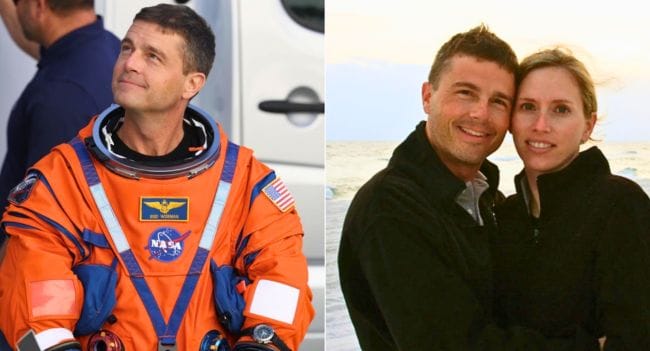
What was meant to be a defining milestone for Artemis II quickly turned into something far more personal—something that no mission briefing, no rehearsal, and no training could have prepared them for. As Commander Reid Wiseman stood alongside his crew, the atmosphere in the room carried the usual weight of history in the making. But within seconds, that feeling shifted into something deeper, quieter, and unexpectedly emotional.
The announcement itself was simple, almost understated. A newly recognized lunar crater—etched permanently into the surface of the Moon—had just been named in honor of someone profoundly important to Wiseman. It wasn’t just a scientific update or a symbolic gesture. It was a tribute to the woman he had lost, someone who never had the chance to witness this moment beside him, yet somehow became a part of it in the most lasting way possible.
For a brief moment, the room fell completely silent. No applause, no immediate reaction—just stillness. It was the kind of silence that doesn’t come from uncertainty, but from understanding. Everyone present seemed to grasp the weight of what had just been said, how something so vast and distant could suddenly feel so close, so human.
Then the emotion broke through. What began with Wiseman quickly spread to the rest of the crew, as if the boundary between personal grief and collective experience had dissolved. Tears followed—not just from one man remembering someone he loved, but from a group of astronauts who understood, perhaps more than anyone, what it means to carry something deeply personal into a mission that represents all of humanity.
In that moment, space exploration stopped feeling distant or technical. It became intimate. The Moon, often seen as a symbol of ambition and discovery, transformed into something else entirely—a place where memory could live, where loss could be honored in a way that transcends time and distance. The idea that a piece of that vast, silent landscape now carried her name gave the moment a kind of permanence that words could barely capture.
For Wiseman, the journey had always been about more than just reaching farther into space. Like many astronauts, he carried pieces of his life with him—memories, relationships, moments that shaped who he is. But this tribute made those invisible things visible. It turned something deeply personal into something written into the universe itself.
What makes this moment resonate so strongly with people around the world is its simplicity. There were no dramatic gestures, no carefully planned speeches—just a quiet acknowledgment that love and loss don’t stay behind on Earth when astronauts leave. They travel with them, shaping their experience in ways that science alone cannot explain.
Even those watching from afar could feel the shift. Social media quickly filled with reactions, with people describing it as one of the most emotional moments connected to NASA in recent memory. Not because of its scale, but because of its honesty. It reminded everyone that behind every mission patch and every launch countdown are real people with stories that don’t end when the rockets ignite.
And then came what Wiseman said next—a reflection that many are still talking about. Though his words were simple, they carried a weight that reached far beyond that room. He spoke not just about loss, but about presence—about how someone can still be with you, even when they’re no longer physically there. It was a reminder that some connections aren’t limited by distance, time, or even life itself.
By the time the moment passed, the atmosphere had changed completely. What had started as a celebration of progress and exploration had become something else entirely—a shared experience of remembrance, connection, and quiet understanding. It was no longer just about the mission. It was about what it means to be human, even in the most extraordinary circumstances.
Because in the end, that’s what made this moment so powerful. Not the history being made, not the distance traveled, but the realization that even in the vastness of space, the most important things we carry are the ones we can’t see—and the ones that never truly leave us.