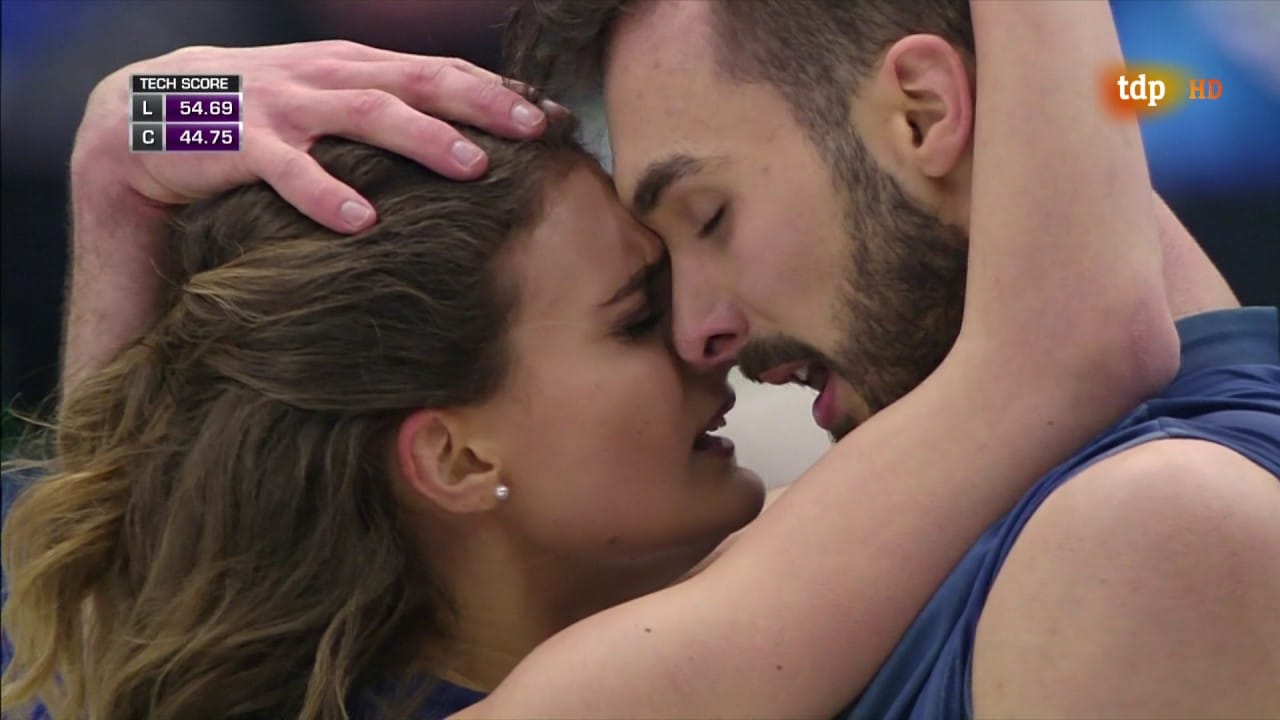
There’s something different about a performance when nothing is at stake—no medals, no rankings, no pressure to prove anything. And yet, when Gabriella Papadakis and Guillaume Cizeron stepped onto the ice at the European Figure Skating Championships Gala in Ostrava, what unfolded didn’t feel smaller. If anything, it felt more powerful than anything they had done under competitive pressure.
Set to “Believer,” the performance immediately carried a different kind of energy. There were no elaborate costumes or dramatic lighting cues designed to impress judges. Instead, they appeared in simple, understated outfits, moving under soft blue lights that seemed to quiet the entire arena. It created a space where nothing distracted from what truly mattered—their connection.
From the very beginning, their movements felt stripped down, almost intimate. Without the urgency of scoring points or executing required elements, every glide seemed more deliberate, more intentional. It didn’t feel like they were performing for an audience—it felt like they were sharing something with each other, and the audience just happened to be watching.
As the routine unfolded, the absence of pressure became its own kind of intensity. There were no obvious peaks or dramatic builds meant to earn applause. Instead, the performance moved like a quiet conversation, flowing naturally from one moment to the next. Every step felt connected, every transition seamless, as if they were speaking a language only they fully understood.
What stands out most is how controlled everything feels without appearing rigid. Their timing remains exact, their synchronization nearly flawless, but there’s a softness to it—a sense of ease that’s rarely seen in competitive programs. It’s precision without tension, mastery without force.
Viewers revisiting the performance are noticing just how different it feels compared to their Olympic routines. There’s a vulnerability here that doesn’t usually show itself when medals are on the line. And yet, that vulnerability doesn’t take away from their skill—it reveals it in a deeper, more human way.
There’s a moment in the middle of the routine where everything seems to slow down. The music softens, their movements become even more subtle, and the entire arena feels like it’s holding its breath. It’s not a highlight in the traditional sense, but it’s the moment people remember—the point where the performance stops feeling like skating and starts feeling like something else entirely.
Their connection during that moment is what truly defines the piece. It’s not about perfect alignment or mirrored steps—it’s about awareness. The way they respond to each other, adjust without thinking, and move as if they share the same instinct creates an experience that feels almost unreal.
What makes this gala performance so compelling is that it offers a rare glimpse into who they are without the framework of competition. It shows what remains when you remove the pressure, the expectations, and the need to win. And what remains is something incredibly refined, deeply personal, and quietly powerful.
Many fans now see this performance as one of the clearest expressions of what made them special long before Olympic gold. Not just their technique, but their ability to create something that feels alive—something that doesn’t rely on spectacle, but on connection.
Because in the end, this wasn’t about proving anything. It was about revealing something. And maybe that’s why it continues to draw people back—because sometimes, the most unforgettable performances are the ones where nothing is at stake… except the truth of what’s being shared on the ice.