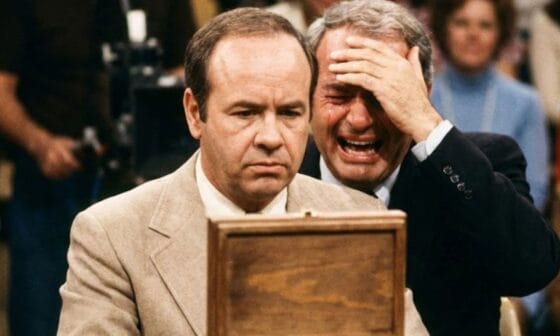
“Tim… please stop… I can’t breathe.” The instant Harvey Korman managed to get those words out, it was already over. The sketch had officially lost control, not because anything went wrong, but because everything went too right. What was supposed to be a structured comedy bit suddenly transformed into something far more unpredictable, as Tim Conway stepped into the scene as the unforgettable “Dr. Nose,” carrying a prop so absurd it instantly shifted the entire energy of the room.
From the very moment Conway appeared, there was a quiet understanding that the script no longer mattered. His entrance wasn’t loud or chaotic in the traditional sense, but it carried a strange confidence that made everything funnier. He played it completely straight, acting as if nothing about his character was unusual, which only amplified the absurdity. It was that contrast—the seriousness of his delivery against the ridiculousness of the situation—that began to crack the foundation of the sketch
Korman, a seasoned professional known for his impeccable timing and composure, tried to hold it together. He turned his face away from the camera, bit his lip, and attempted to redirect his focus, but it was clear that he was fighting a losing battle. Every second that Conway stayed in character made it harder to maintain control, and the tension between staying professional and giving in to laughter became visible to everyone watching.
The audience could feel it building, that fragile moment where comedy teeters on the edge of collapse. There’s a unique kind of anticipation when viewers sense that something unscripted is about to happen, and in this case, it was almost unbearable. The laughter started to ripple through the crowd, not because of a punchline, but because of the visible struggle unfolding on stage.
Then came the line that would cement the moment forever. Conway leaned in slightly, maintaining his calm and composed demeanor, and delivered it with perfect timing: “This might sting a little.” It wasn’t shouted or exaggerated—it was simple, quiet, and devastatingly effective. That contrast made it impossible to resist, and the moment the words landed, Korman completely lost it.
What followed wasn’t just laughter—it was a complete breakdown. Korman couldn’t recover, and the audience erupted into uncontrollable laughter that filled the entire studio. The stage, once guided by a script, dissolved into pure spontaneity. It was no longer about delivering lines or hitting marks; it was about surviving the moment, and no one could.
What makes this scene so powerful is not just the humor, but the authenticity behind it. In an era where television often relied on tight scripting and polished delivery, this moment stood out because it was real. You could see the genuine reactions, the unscripted laughter, and the human side of performers who were supposed to remain in control at all times.
This wasn’t the first time Conway had pushed his fellow cast members to the edge, but this particular moment felt different. There was something about the perfect combination of timing, character, and unpredictability that made it unforgettable. It wasn’t just about being funny—it was about breaking through the boundaries of performance and revealing something honest underneath.
Moments like this remind us why comedy resonates so deeply. It’s not always about the perfect joke or the cleverest line, but about connection, surprise, and the shared experience of losing control together. When performers break, the audience follows, and that shared laughter creates something that feels almost timeless.
Even years later, this scene continues to circulate, drawing in new audiences who experience it as if it’s happening for the first time. It doesn’t rely on context or buildup; its power lies in its simplicity and truth. Two legends on stage, one pushing the other just far enough to cross the line between performance and reality.
That’s why this moment still lives on—not because it was flawless, but because it wasn’t. It was messy, unpredictable, and completely genuine. And in that brief collapse of composure, Tim Conway and Harvey Korman created something that no script ever could: a piece of comedy history that feels as alive today as it did the moment it happened.