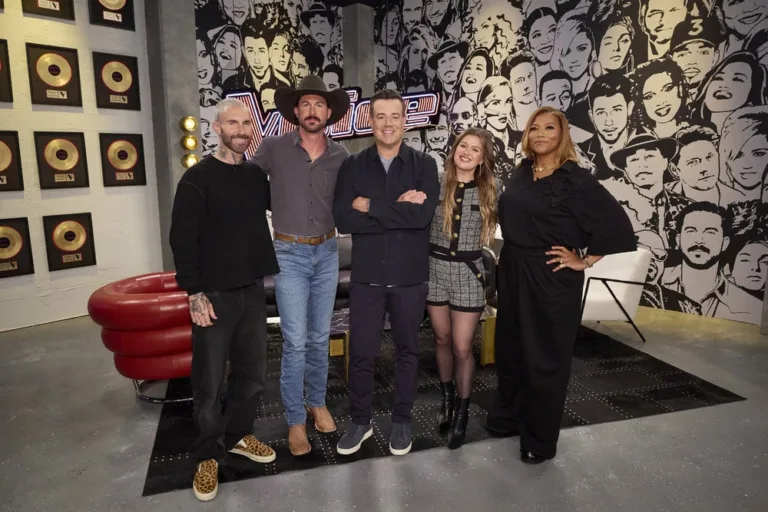
The Voice Season 30 has barely begun, but the competition is already taking shape. After three nights of Blind Auditions, all four coaches have assembled their first groups of artists, with several performers already standing out as names to watch.
Adam Levine and Kelly Clarkson returned to the coaching panel, while Queen Latifah and Riley Green made their coaching debuts. The new lineup has created plenty of competition, especially as the coaches battle over singers they believe could go far.
The season also introduced the new First-In button. Each coach can use it once during the Blind Auditions when they are the first to turn, allowing them to immediately claim an artist instead of letting the contestant make the final choice.
The first week produced several major moments, including multiple four-chair turns. Ferryn and Brinkley Wright, Koumba Diallo, Lexi Stephens, Kyle Davis and Amanda Mikkel all generated turns from all four coaches, although each ultimately ended up on a different team.
Team Adam currently includes Destinee Monroe, Owen Uffens, Lexi Stephens and Amanda Mikkel. Levine also made one of the most important moves of the opening week when he used his First-In button to secure Mikkel after her four-chair audition.
Team Kelly has quickly become the largest group, with Hazel Gerson, Brianna Cameron, Koumba Diallo, Johnnie Kapua, Kyle Davis and Brooklyn Marie joining Clarkson.
Team Queen includes BigCountry, Marcus Ladden Jr., Mia Knight, Alt Bloom and Morgan Lett. Latifah has already shown that she is willing to make aggressive moves to secure artists, including using her First-In button on 16-year-old Mia Knight.
Meanwhile, Team Riley has Joe Henley, Ferryn and Brinkley Wright, Caroline Alexis, Harmony McKee and Kenna Elpers. Green has already attracted several country performers, giving his team a distinct musical identity early in the competition.
One of the most talked-about developments has been the number of standout artists spread across the four teams. With several four-chair turns already accounted for, the coaches have very different groups heading into the next stage.
The early team sizes also don’t necessarily tell the whole story. A smaller team can still contain several artists who made especially strong impressions during their auditions, while larger teams give coaches more options when the competition becomes tougher.
The Blind Auditions are only the beginning, and the artists will eventually have to prove themselves in the Battle Rounds and beyond. That’s when the coaches’ early choices will really start to be tested.
For now, Season 30 has already delivered plenty of memorable performances, new twists and intense coach competition. With the teams taking shape, the next question is which artists can turn an impressive Blind Audition into a deep run.