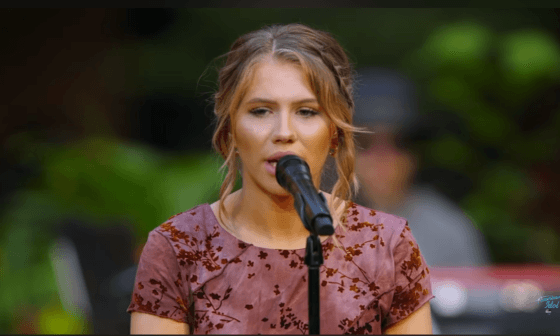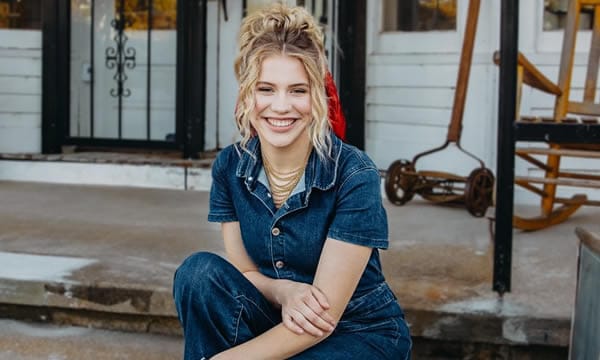
Hannah Harper didn’t walk into American Idol chasing spectacle. She arrived quietly, carrying an acoustic guitar, a life shaped by motherhood, and a voice that immediately stopped the room. What followed wasn’t just a standout audition — it was the beginning of fans realizing there is far more to her story than what fit into a few minutes of television.
The moment that first captured national attention came when her original song brought Carrie Underwood to tears. It wasn’t a dramatic breakdown or a soaring vocal climax. It was the honesty. Hannah sang about everyday life, exhaustion, love, and purpose with a calm clarity that felt deeply lived-in. That emotional authenticity is the first thing many viewers are still processing.
What fans are now discovering is that Hannah didn’t “find” music recently — she was raised in it. She grew up performing in a family bluegrass gospel band, traveling and singing long before television cameras ever followed her. Music wasn’t a dream she chased later in life; it was the language she learned first.
Another detail quietly resonating with audiences is her songwriting approach. Hannah doesn’t write for trends or radio formulas. Her songs are rooted in ordinary moments — toys on the floor, reheated coffee, small hands asking for attention. That ability to turn the mundane into meaning is why so many listeners have compared her storytelling to Dolly Parton.
Fans are also learning that her confidence isn’t loud by design. Hannah performs with restraint, letting silence, pacing, and emotion do the work. Judges noted that she doesn’t rush moments or over-sing — a rare instinct that often takes artists years to develop. That quiet control is now being recognized as one of her greatest strengths.
Behind the scenes, Hannah is also a mother of three navigating postpartum depression — a truth she shared openly and without embellishment. Rather than framing it as tragedy, she transformed that season into songwriting. For many viewers, especially parents, this honesty created an immediate connection that felt personal rather than performative.
Another surprising detail is how intentional she is about image. The homemade patchwork dress she wore wasn’t a gimmick or a costume. It reflected how she lives — resourceful, creative, grounded. Fans quickly embraced it as an extension of her identity rather than a branding choice.
Viewers are also noticing how other contestants react to her presence. Even offstage clips show people listening closely when Hannah sings, leaning in rather than talking over the moment. That kind of quiet gravity is rare early in a competition.
Judges Luke Bryan and Lionel Richie both hinted that her growth curve could be steep, noting that her foundation — storytelling, tone, and emotional intelligence — can’t be taught easily. Technique can be refined, but instinct like hers is harder to find.
As more clips surface and performances are replayed, fans are beginning to realize that Hannah Harper didn’t just earn a unanimous YES — she introduced a presence that could define the season. Not because she demands attention, but because she holds it without effort.
What Idol fans are only just discovering is that Hannah Harper isn’t simply advancing in a competition. She’s revealing a kind of artistry that feels rooted, patient, and lasting — the kind that doesn’t burn bright and fade, but grows quietly and stays.