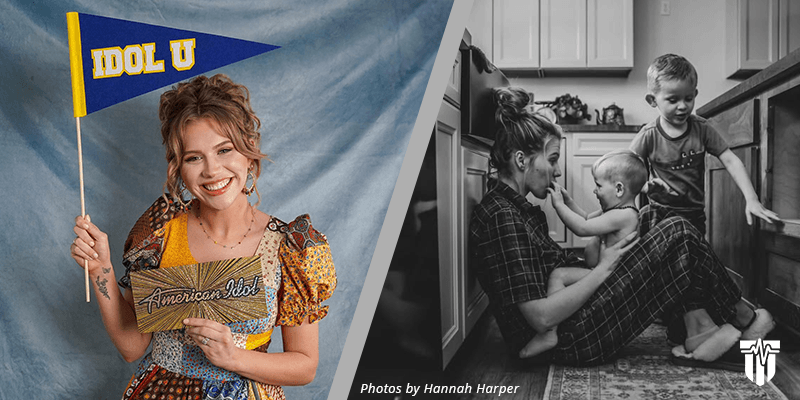
When Hannah Harper walked onto the stage of American Idol, there was nothing flashy about her entrance. Dressed in a simple homemade patchwork dress, she looked more like someone attending a small-town gathering than a national television competition. A mother of three, she introduced herself quietly, almost apologetically — the kind of presence easy to underestimate.
Then she began to sing.
The song was not a cover, not a safe choice designed to impress judges. It was an original — written during what she later described as the darkest chapter of her life. From the first lyric, the mood in the room shifted dramatically. What started as a routine audition quickly became something far more intense and deeply personal.
Her voice carried a raw, unpolished honesty that felt impossible to ignore. It wasn’t technically showy, but it didn’t need to be. Every word landed with emotional weight, as if each line had been pulled directly from lived experience rather than crafted for performance.
Within moments, the room fell into complete stillness. Judges stopped taking notes. No one interrupted. Even the usual background movement of a television set seemed to fade away. It was the kind of silence that only happens when people realize they are witnessing something genuine.
As the lyrics unfolded, the emotional impact became visible. Carrie Underwood reached for tissues, her eyes glistening as the story hit closer to home than expected. Luke Bryan sat quietly, visibly struggling to find words strong enough to match the moment.
Comparisons quickly surfaced to legends like Dolly Parton and Alison Krauss. Not because Harper imitated their sound, but because she carried something they share — the ability to transform personal pain into universal storytelling.
What made the performance so powerful was its lack of pretense. There was no attempt to hide her vulnerability or smooth over difficult emotions. Instead, she leaned into them, allowing the song to feel unfiltered and real in a way rarely seen on a televised stage.
By the time she reached the final note, the emotional tension in the room was undeniable. The silence that followed felt heavy — not uncertain, but reverent. It was clear that this was no longer just an audition segment. It had become a shared emotional experience.
For viewers, the moment lingered long after the episode ended. Social media reactions poured in, many describing the performance as “devastatingly beautiful” and “impossible to forget.” Fans began asking whether they had just witnessed the emergence of a defining voice of the season.
In the end, Hannah Harper didn’t just walk off the stage as another contestant. She left as the center of a moment that felt bigger than a competition — a reminder that the most unforgettable music doesn’t come from perfection, but from truth. One song. One voice. One reckoning that changed everything.