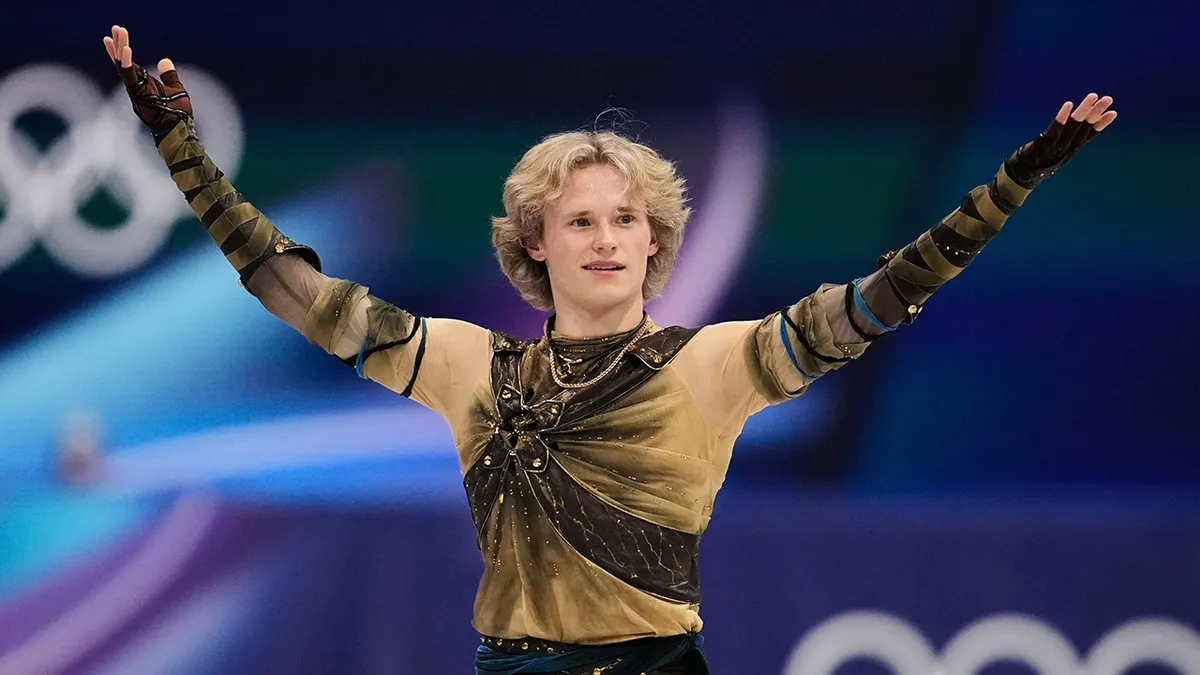
Ilia Malinin did not need words to command attention as he stepped onto the ice for the closing gala at the Milano Cortina Games. Known worldwide as the “Quad God” for his unprecedented technical mastery, Malinin chose a very different kind of performance this time — one that prioritized emotion over athletic spectacle. From the moment the music began, it was clear this would not be about records, medals, or difficulty levels. Instead, it felt like a deeply personal reflection unfolding in real time.
The routine carried a weight that audiences could immediately sense. Rather than opening with explosive jumps, Malinin moved slowly and deliberately, almost as if he were carrying an invisible burden. His choreography leaned heavily into expressive body language, using stillness and controlled movements to tell a story. Every glide and turn appeared intentional, communicating something far more powerful than technical brilliance ever could.
Many viewers interpreted the performance as a response to the immense pressure he has faced in recent years. Since rising to fame as one of figure skating’s most revolutionary athletes, Malinin has lived under constant scrutiny. Social media amplified every success but also magnified every setback, turning even minor mistakes into global conversations. For a young athlete still navigating his identity, that level of attention can be overwhelming.
His Olympic disappointment added another layer to that pressure. Expectations had been sky-high, with many predicting a historic victory that would cement his legacy instantly. When reality did not match those predictions, criticism followed swiftly. The gala performance seemed to acknowledge that experience — not as a moment of defeat, but as a defining challenge in his journey.
Throughout the routine, the music built in waves, mirroring the emotional highs and lows of an athlete’s life in the spotlight. At certain moments, Malinin paused mid-ice, looking outward toward the audience in a way that felt almost confrontational yet deeply vulnerable. These pauses created a sense of tension, as though he were inviting viewers to reflect on their role in the pressures he has endured.
What stood out most was his choice to avoid showcasing his signature quadruple jumps. For a skater known for pushing the limits of technical difficulty, this absence spoke volumes. It signaled that this performance was not about proving anything physically. Instead, it was about reclaiming control of his narrative and redefining what strength looks like beyond competition results.
Fans and commentators alike described the routine as one of the most mature performances of his career. It demonstrated an evolution not just as an athlete, but as an artist capable of translating personal struggles into a universal message. In doing so, Malinin reminded audiences that behind every elite performer is a human being navigating expectations, criticism, and self-doubt.
The symbolism of the gala setting added further depth to the moment. Unlike competitive programs judged on points and precision, gala performances allow skaters creative freedom. Malinin used that freedom to transform the ice into a stage of emotional storytelling, shifting the focus from achievement to resilience.
By the end of the routine, the arena fell into a rare silence before applause erupted. It was the kind of quiet that follows a powerful statement — the collective realization that something meaningful had just been witnessed. Without speaking a single word, Malinin had communicated a story of pressure, struggle, and determination.
Ultimately, the performance stood as a reminder that true greatness is not measured solely by medals or technical milestones. It is also defined by the courage to confront adversity openly and authentically. In that silent yet deeply expressive routine, Ilia Malinin showed that resilience can be as breathtaking as any quadruple jump.