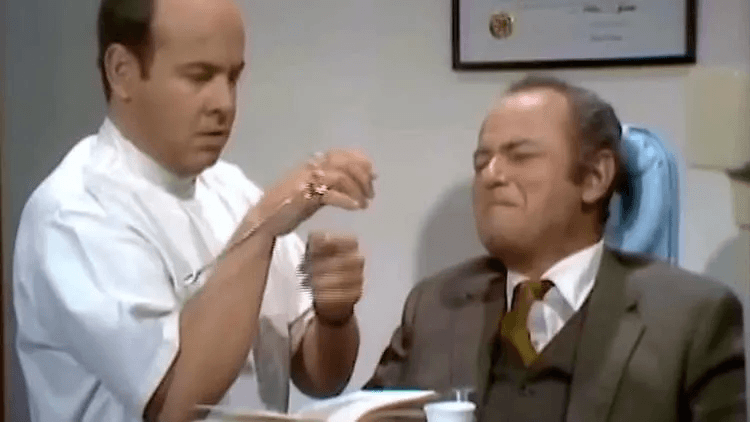
One straight face was all it took for an entire room to collapse into laughter. In the legendary “cannonball” sketch, Tim Conway proved once again that comedy doesn’t need noise or exaggeration to be devastatingly effective.
For many viewers, especially those who grew up watching The Carol Burnett Show, this is exactly why the sketch remains endlessly watchable. It captures a style of humor that feels almost impossible today—quiet, patient, and dangerously confident.
Conway enters the scene with no urgency and no visible intention of being funny. His expression never changes. That calm, almost serene presence becomes the weapon that slowly dismantles everyone else on stage.
The absurdity builds not through jokes, but through restraint. Conway allows silence to stretch just a little too long, letting the tension thicken until laughter becomes unavoidable.
Harvey Korman is the first casualty. His professionalism cracks as he fights a losing battle against Conway’s unwavering composure. The harder he tries to stay serious, the funnier the moment becomes.
Carol Burnett isn’t spared either. Once the laughter starts, there’s no recovery. Her reactions only fuel the chaos, turning the sketch into a shared collapse rather than a performance.
Even Conway himself eventually succumbs, ending up on the floor as the carefully controlled calm finally gives way. By then, the damage is done, and the studio is completely lost to laughter.
What makes the sketch timeless is the absence of obvious punchlines. There’s no scripted explosion, no forced payoff. The humor arrives naturally, detonated by timing rather than noise.
This is comedy built on trust—trust in the audience, trust in silence, and trust that doing less can sometimes do far more. It’s a reminder that restraint can be far more powerful than excess.
Some comedy doesn’t fade with time. It sharpens. Each rewatch reveals something new, and the laughter hits just as hard, proving that true comedic genius doesn’t age—it only gets better.