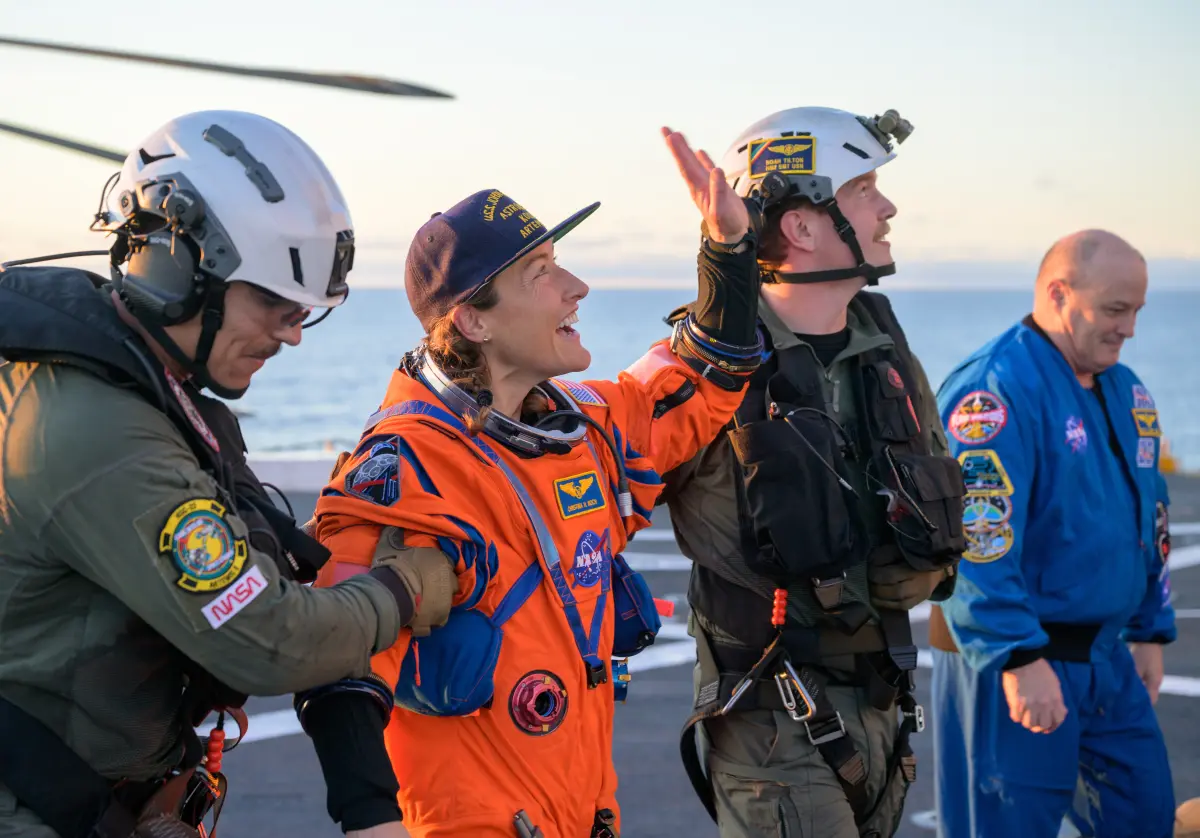
What should have been a triumphant return quickly revealed a side of space travel most people never see. After completing their journey on Artemis II, the astronauts didn’t step out of the capsule with confidence and ease—instead, they struggled to walk, needing support as their bodies tried to readjust to something as basic as gravity.
At first glance, the moment shocked viewers. These are highly trained astronauts—people at the peak of physical and mental conditioning. Yet within seconds of returning to Earth, even standing upright became a challenge. It wasn’t weakness—it was biology.
After spending days in microgravity, the human body begins to change faster than most realize. Without the constant pull of gravity, muscles that normally support posture and movement start to weaken. The legs, especially, lose strength because they’re no longer needed to carry body weight in the same way.
But it doesn’t stop there.
The inner ear, which plays a crucial role in balance, also adapts to the weightless environment. In space, the body no longer relies on the same signals to orient itself. So when astronauts return to Earth, their sense of balance is disrupted, making simple actions like walking feel unfamiliar and unstable.
That’s why, after landing, astronauts are often seen being assisted. It’s not just precaution—it’s necessary. Their bodies are essentially relearning how to function under gravity, step by step, moment by moment.
For many viewers, this viral footage has become a reality check. Space missions are often shown as moments of achievement—launches, spacewalks, breathtaking views of Earth. But what happens after the return is rarely highlighted, even though it’s one of the most physically demanding phases.
Experts have long explained that recovery is part of every mission. Medical teams monitor astronauts closely after landing, guiding them through rehabilitation as their muscles rebuild strength and their balance systems recalibrate. What looks like a simple walk is actually a complex process happening inside the body.
There’s also a psychological layer to the experience. After adapting to life in space, returning to Earth isn’t just a physical adjustment—it’s a mental one as well. The environment feels heavier, movements feel slower, and the body no longer responds the way it did just days before.
What makes this moment so impactful is how quickly the change becomes visible. It reminds people that space travel isn’t just about reaching new distances—it’s about what the human body endures along the way. Every mission leaves a mark, even after a successful return.
Now, as the footage continues to spread, more people are beginning to understand the full picture. Not just the glory of exploration, but the cost of it. The unseen effort that begins the moment astronauts come home.
Because this isn’t just a landing.
It’s the start of recovery.
And in many ways, it’s one of the hardest parts of the journe