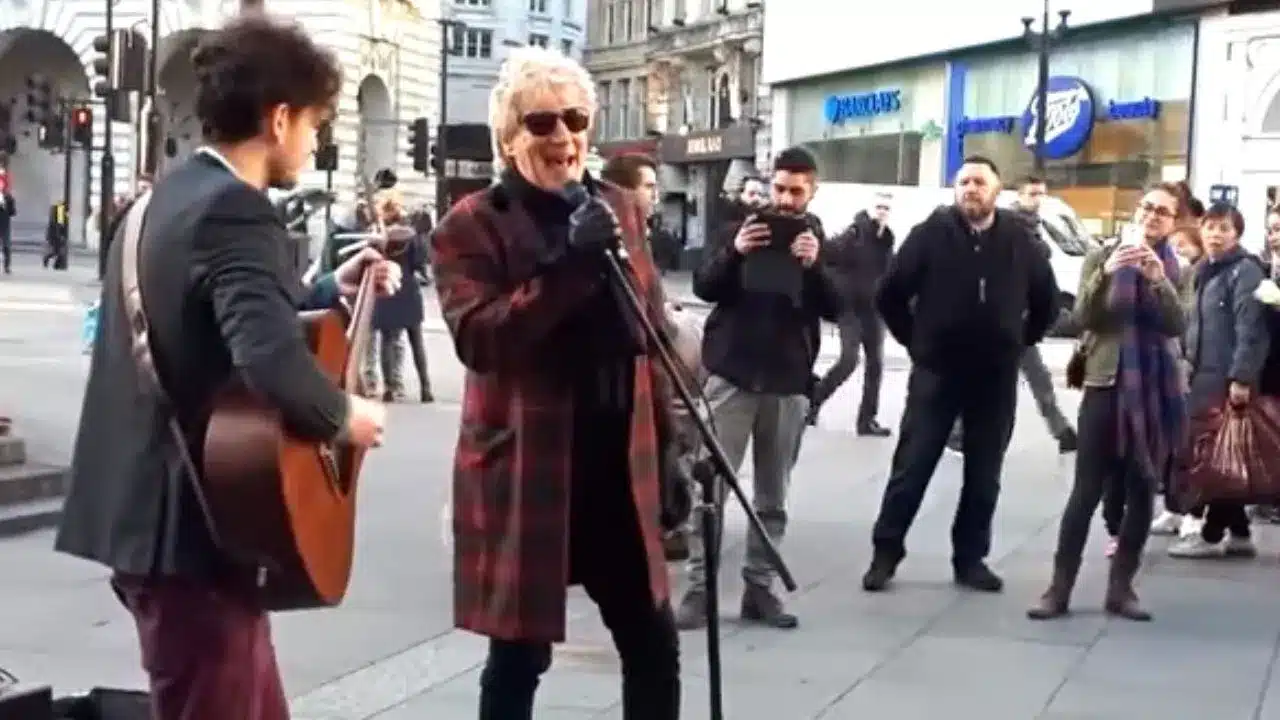
Picture this: a chilly London afternoon, Piccadilly Circus buzzing with life, streetlights flickering on as commuters hurry past. Among the noise and movement, the soulful strum of a guitar cuts through — Henry Facey, a busker pouring his heart into one last song before heading home. His choice? The haunting classic “Handbags and Gladrags.”
And then, like a scene out of a dream, the crowd parts. Out steps Rod Stewart. Not onto an arena stage, not into the spotlight of a stadium — but right onto the pavement beside Henry. With a grin, Rod asks if he can join in. Henry, stunned but overjoyed, hands him the mic. In an instant, the everyday becomes unforgettable.
Rod’s raspy, unmistakable voice blends with Henry’s guitar, echoing against the city streets. Strangers pause, phones lift, and Piccadilly becomes an impromptu concert hall. For a few precious minutes, music belongs to everyone — free, unfiltered, and alive. A living legend and a hardworking busker, side by side, proving once again that magic often appears where we least expect it.
But music has always had a way of creating these once-in-a-lifetime moments. Nearly half a century earlier, on a December night in 1982, another legend took his final bow under very different circumstances. Marty Robbins, weakened by a failing heart, walked onto the Grand Ole Opry stage for what would be his last performance. His song that night? “Don’t Worry.”
Originally released in 1961, “Don’t Worry” had already carved its place in history. A studio accident with guitarist Grady Martin’s amplifier produced a distorted “fuzz” sound — the first of its kind — and turned the song into both a country classic and a groundbreaking experiment. It topped the Billboard charts, but more importantly, it comforted audiences with Robbins’ warm, unshakable voice.
In his final performance, “Don’t Worry” wasn’t just a hit — it was a farewell. A message from an artist whose body was frail but whose spirit never wavered.
Two moments, two legends, decades apart. One on a bustling London street, the other beneath the revered lights of the Opry. Both reminding us that music’s greatest power isn’t in fame or charts — it’s in its ability to surprise us, move us, and stay with us long after the last note fades.