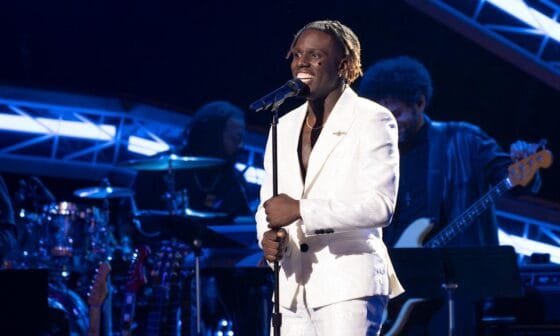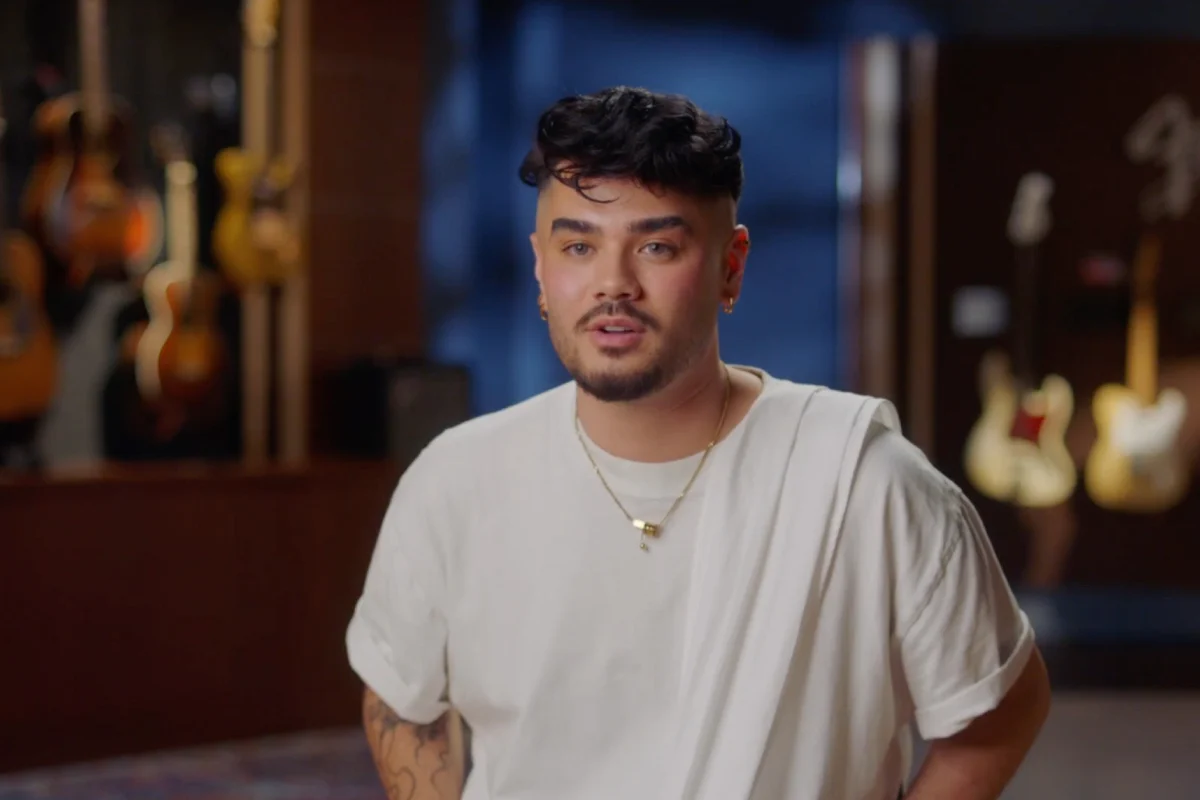
When Sheldon Riley stepped onto the American Idol stage on the February 2 episode, it wasn’t just another audition—it was the unveiling of a decade-long journey toward self-acceptance. The 26-year-old Australian singer stood before judges Luke Bryan, Lionel Richie, and Carrie Underwood not in costume, not behind a persona, but as himself.
Riley shared that ten years earlier, he had been rejected from an Australian competition show—a moment that deeply shook his confidence. The experience made him feel invisible, convincing him that who he truly was might never be enough to be seen or heard.
In response to that rejection, Riley did what many artists do when they feel unseen—he reinvented himself. He created an avant-garde persona built on dramatic masks, glittering crystals, diamonds, and unforgettable fashion. The spectacle worked. People noticed. Doors opened. He advanced through competition shows across Australia and onto the global stage.
But with each performance, the costumes grew bigger, the masks more elaborate, and the pressure to remain unforgettable intensified. Riley admitted it became almost addictive—the need to be the most visually striking person in the room, no matter the cost.
Behind the applause and attention, however, was a painful truth. Riley confessed that when he returned home and stripped away the makeup and disguises, he struggled to recognize himself. The persona that brought him success also brought self-loathing, leaving him disconnected from the person behind the performance.
That realization led him to step away from music entirely for two years. During that time, Riley returned to the simple reason he fell in love with singing in the first place—not for attention or spectacle, but for connection and expression. He made a promise to himself: no more characters, no more masks.
That promise carried him to the Idol stage, where he performed Brother, delivering a raw, emotionally restrained performance that relied solely on his voice. The room felt different—quiet, focused, and visibly moved.
Luke Bryan praised his talent without hesitation, telling him he never needed a mask in the first place. Lionel Richie went further, urging Riley to accept and embrace himself, calling him authentic and fully formed as an artist. Carrie Underwood simply said she was glad he was there and that she loved his voice.
With three unanimous yeses, Sheldon Riley earned his Golden Ticket to Hollywood. But the victory went far beyond advancing in the competition—it marked the first time he had been accepted on a major stage without hiding.
Afterward, Riley reflected on the moment with honesty and relief. For the first time, he wasn’t judged as a character or a spectacle, but as himself—and he was enough. For Sheldon Riley, the mask is finally off, and his American Idol journey is no longer about reinvention, but about becoming fully seen.