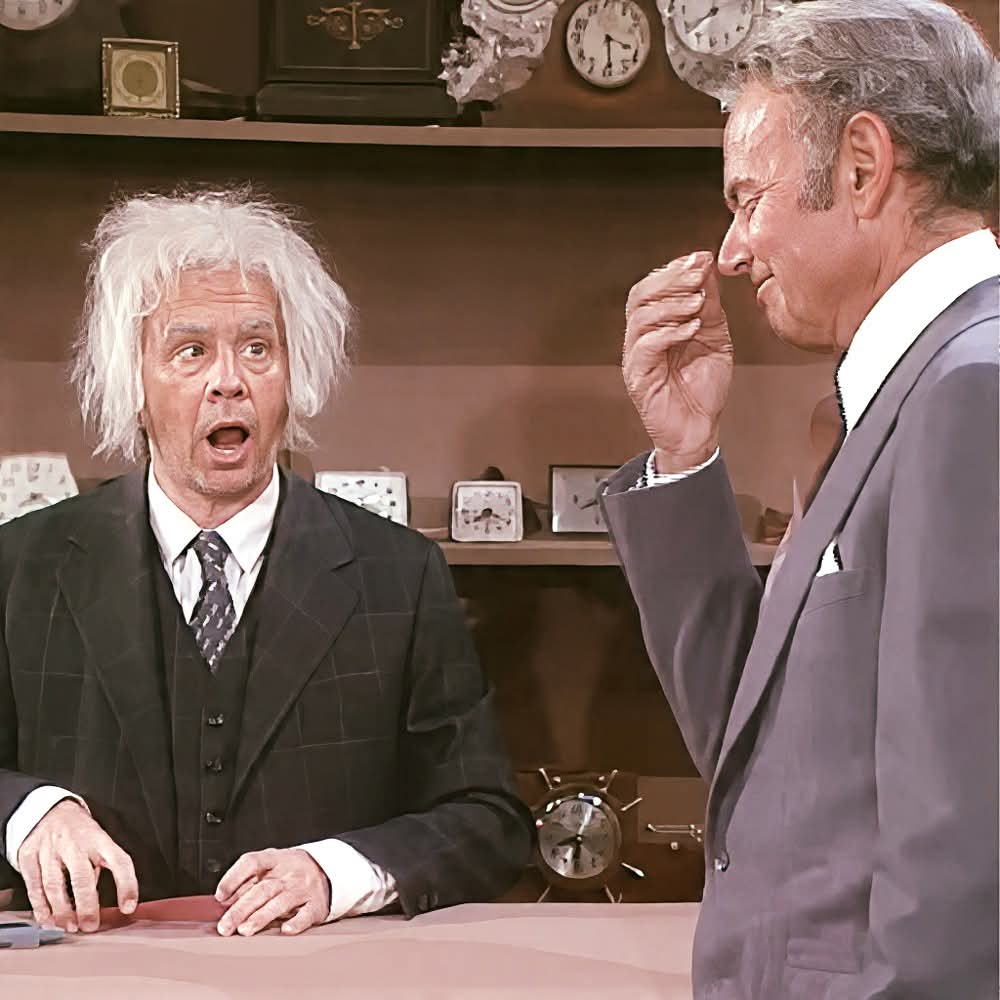
“Are you sure it’s still ticking?” Harvey Korman barely gets the question out before Tim Conway shuffles into the room as The Oldest Man — and just like that, another legendary Carol Burnett Show meltdown is set in motion.
The premise couldn’t be simpler: a routine clock repair. But when Conway takes on even the smallest task, simplicity disappears. His character moves at a glacial pace, every shuffle exaggerated, every glance delayed just long enough to stretch the audience’s anticipation to the breaking point.
From the very first step toward the clock, the crowd senses what’s coming. Conway doesn’t rush a single movement. Reaching for a tool becomes a journey. Adjusting a tiny gear feels like a full act of theater. The silence between actions grows thicker — and funnier — by the second.
Harvey Korman, playing the straight man, does everything in his power to hold the scene together. His posture stiffens, his eyes narrow with concentration, and his lips press tightly as he fights the urge to laugh. But Conway’s perfectly calibrated pauses keep catching him off guard.
Then the mishaps begin.
A tool slips. A part shifts unexpectedly. Conway reacts with absolute seriousness, as though nothing unusual has happened. That unwavering commitment is what makes it brilliant. He never signals the joke — he is the joke, completely immersed in the absurdity.
The audience becomes part of the rhythm. Laughter erupts not just at the physical comedy, but at the waiting — the delicious stretch of time before the next tiny disaster unfolds. Conway understood that sometimes the funniest moment isn’t the punchline, but the pause right before it.
Korman’s struggle only heightens the chaos. A twitch here. A quick glance away there. The harder he tries to stay composed, the more the audience roars. It’s a live battle between discipline and inevitability — and Conway knows he’s winning.
What makes the “Clock Repair” sketch endure decades later is its restraint. There’s no shouting, no frantic slapstick. Just masterful timing, microscopic movements, and a performer who knew exactly how far to push without breaking character himself.
By the time the repair spirals into a series of tiny, perfectly timed disasters, the script has almost become secondary. What remains is pure, unscripted magic — the kind that only happens when trust, talent, and timing collide.
And through it all, as Harvey tries desperately to survive, Tim Conway simply keeps ticking.