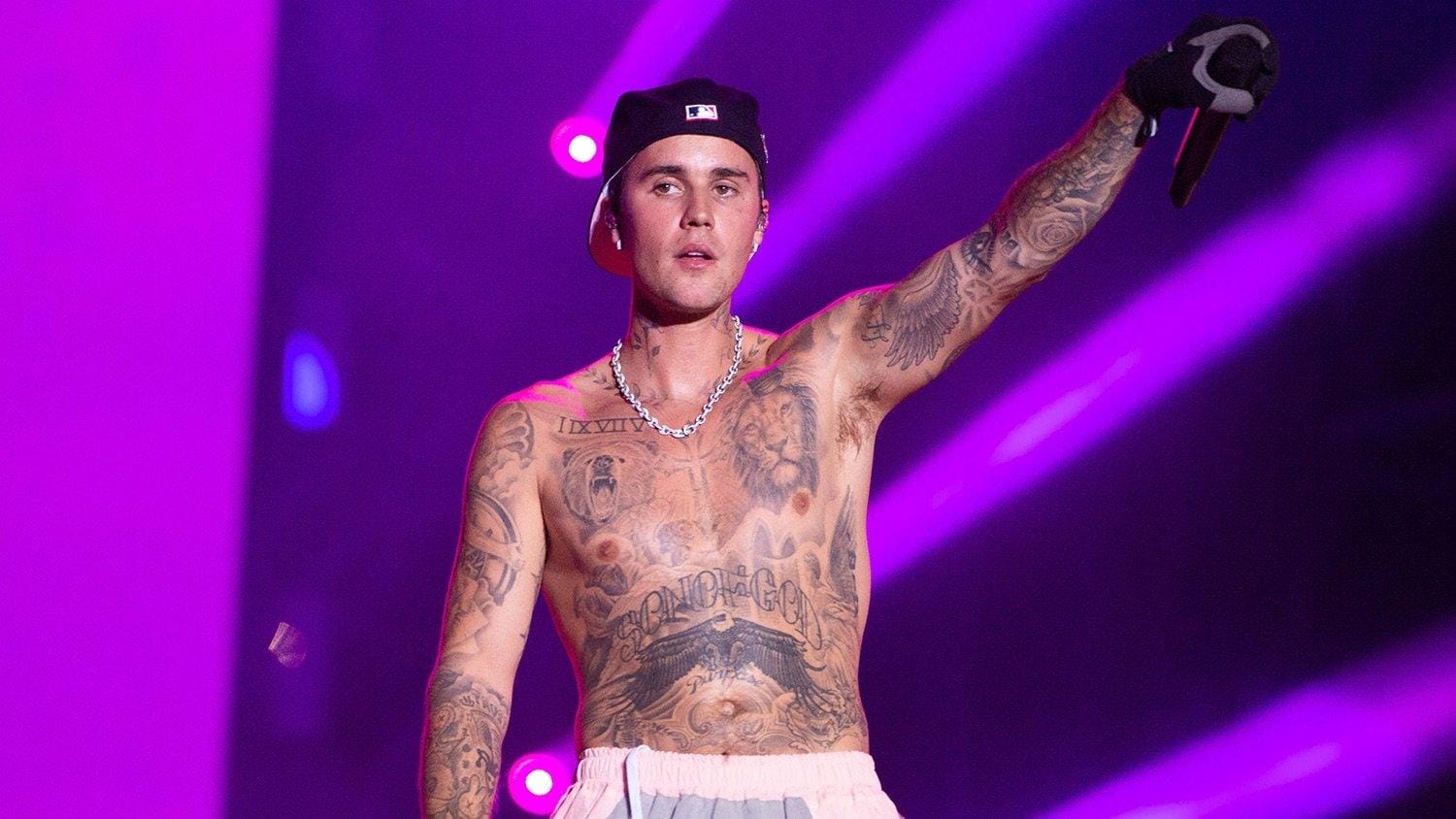
It was already a massive night at Coachella, with over 100,000 fans packed into the desert, lights flashing and energy at its peak. Justin Bieber stood at the center of it all, performing “One Less Lonely Girl” like he had done many times before. But what no one expected was how quickly the night would turn into something far more personal.
The moment didn’t start with a big announcement or dramatic buildup. It started quietly—with Hailey Bieber. Standing near the stage, she made a small, almost playful move. A gentle push.
And suddenly, Billie Eilish was on stage.
At first, it didn’t even feel real. Billie’s reaction said everything—laughter, disbelief, and a kind of shock that couldn’t be hidden. This wasn’t just a surprise appearance. This was a moment colliding with her past, something fans knew carried deeper meaning.
Because long before the fame, before the awards, before the headlines, Billie Eilish was a fan. A real one. The kind who had posters on her walls, who watched performances from the other side of the screen, imagining what it might feel like to be there.
Now, she wasn’t just there—she was in the center of it.
As Justin Bieber continued singing directly to her, the crowd began to realize what they were witnessing. This wasn’t just part of the show. It was something unplanned, something emotional, something that couldn’t be recreated.
The energy shifted instantly. What had been loud and electric turned quiet, almost reverent, as thousands of people watched a dream unfold in real time. And then, just as quickly, it erupted—cheers, screams, and a reaction that felt as overwhelming as the moment itself.
Below the stage, Hailey Bieber watched it all happen, smiling in a way that felt different from the crowd’s reaction. There was something knowing in that expression, as if she understood exactly what she had just set into motion.
What makes this moment so powerful isn’t just the surprise—it’s the story behind it. It’s the idea that someone who once dreamed from afar suddenly finds themselves living that dream, not in private, but in front of thousands of people.
Fans quickly picked up on that layer, and within minutes, clips began spreading everywhere. Replays, reactions, comments—people trying to capture the feeling of what they had just seen. Not just a performance, but a full-circle moment.
There’s something universal about that kind of experience. It’s not just about music—it’s about possibility. About the idea that the distance between fan and stage isn’t always permanent. And when that distance disappears, even for a moment, it creates something unforgettable.
As the video continues to circulate, the reaction hasn’t slowed. People aren’t just watching—they’re feeling it. Remembering their own moments, their own dreams, their own versions of standing on the other side of something they once looked up to.
In the end, what happened at Coachella wasn’t just another highlight. It was a collision of past, present, and possibility. A quiet push that turned into something much bigger.
And for a few minutes, in front of over 100,000 people, Billie Eilish didn’t just perform—she lived the moment she once only imagined.