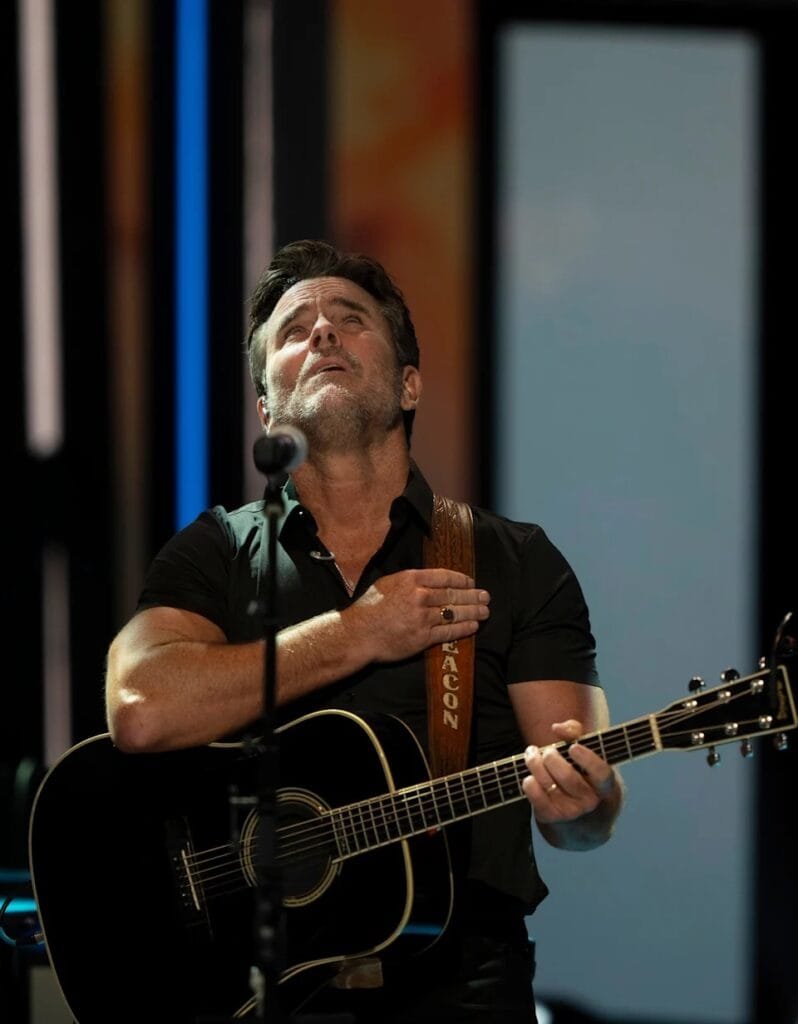
Charles Esten returned to the Grand Ole Opry stage over the weekend, but one portion of his performance became far more personal than an ordinary concert moment.
On August 22, the actor and singer paused his Opry set to honor his former Nashville co-star and longtime friend Hayden Panettiere, who passed away at age 36 on August 16. Esten spoke about the friendship they formed while making the hit television drama before dedicating one of his own songs to her memory.
Behind him, a photograph of Esten and Panettiere appeared on the large screen, giving the performance an especially personal feeling for the audience.
Rather than beginning immediately with the song, Esten first took time to explain what Hayden had meant to him.
He went all the way back to their first meeting, which happened when he was auditioning to play Deacon Claybourne on Nashville. Panettiere had already been cast as Juliette Barnes, and Esten remembered her being supportive of him almost immediately. He recalled that she spoke positively about his audition and encouraged those making the show to consider him for the role.
That audition eventually became the beginning of six seasons working together.
Nashville, which premiered in 2012, blended television drama with country music and required its cast members to perform extensively as musicians as well as actors. Esten and Panettiere consequently spent years acting, recording and singing together.
For Esten, however, their connection went beyond simply being co-stars.
While remembering her after her passing, he described Hayden as an extraordinarily talented person with tremendous charisma and warmth. He also said that one of the greatest gifts of their years together was simply being able to call her his friend.
That history made his choice of song at the Opry particularly meaningful.
Esten dedicated “Somewhere in the Sunshine,” a song from his 2024 album Love Ain’t Pretty, to Hayden. As he performed, the image of the two friends remained visible behind him, turning the Opry stage into a quiet remembrance of their years together.
The moment quickly spread online, where viewers described the tribute as beautiful and deeply emotional.
It was especially moving for fans of Nashville, because seeing Esten performing country music while Hayden’s photograph filled the screen immediately brought back memories of Deacon and Juliette and the world the cast created together.
There was another heartbreaking layer to Esten’s tribute.
Only a short time before Hayden’s passing, Esten had been performing in Greenville, South Carolina, the same city where Hayden was staying. He later described it as a strange coincidence and expressed sadness that they had been so close geographically without getting the chance to see one another again.
That missed opportunity appears to have made Saturday’s Opry performance even more significant.
Esten had already shared a written tribute following the news of Hayden’s passing, remembering their first audition together, their musical collaborations and the friendship she shared with both him and his wife, Patty. Taking those memories onto the Grand Ole Opry stage allowed him to honor her in the environment that connected so closely with the music they once performed together.

Other members of the Nashville family have also remembered Panettiere publicly. Jonathan Jackson, who played Avery Barkley, said he and his wife loved Hayden like a sister, while several other former co-stars have spoken about her talent, humor and generosity.
But Esten’s Opry tribute carried a symbolism that was difficult to miss.
More than a decade earlier, the two actors had stepped into a fictional version of Nashville and helped bring its country-music world to millions of television viewers. Now Esten was standing on one of country music’s most historic real-life stages, singing while a photograph of his friend looked down behind him.
There were no elaborate speeches needed to make the moment powerful.
A photograph, a few memories and “Somewhere in the Sunshine” were enough.
And for the many Nashville fans watching, Charles Esten’s performance became more than another song at the Grand Ole Opry—it was a final, deeply personal salute to a friend whose presence had been intertwined with one of the most important chapters of his career.