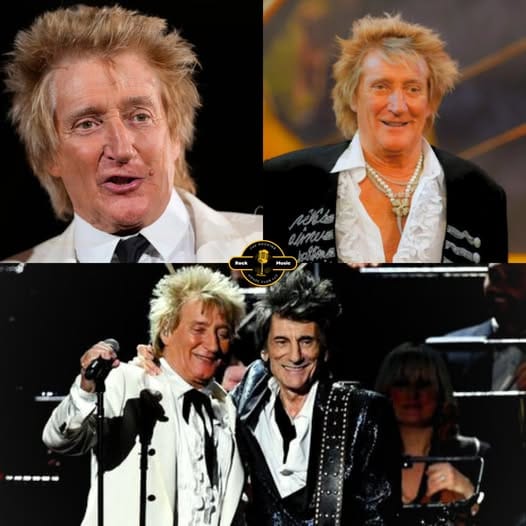
Rod Stewart’s Final Top 40 Hit Wasn’t Just a Song — It Was a Long-Overdue Apology
Some songs come to you when you’re chasing fame. Others wait for you — quietly, patiently — until you’re old enough, wise enough, broken enough to truly mean them.
Rod Stewart’s final climb into the US Top 40 wasn’t some last grasp at pop relevance. It was something quieter. Something sadder. Something healing.
It was a circle finally closing.
Once, They Were the Faces
Before Rod Stewart was Rod Stewart — the feather-haired icon, the raspy-voiced heartbreaker — he was just a young man chasing the echo of something real. He found it, for a time, with a band called Faces.

Alongside Ronnie Lane and Ronnie Wood, Stewart helped build something loud, loose, and electric — blues-rock for the wild-hearted. In 1971, A Nod Is As Good As A Wink…To A Blind Horse put them on the map, thanks in part to the momentum Stewart had just gained from his breakout solo smash, “Maggie May.”
And that’s where the crack began.
The press crowned Faces as Rod’s backing band. Stewart didn’t fight it. Maybe he even liked it. His solo star rose while the band, slowly, started to fade behind him.
Then, in 1973, just as the Faces were set to release their new album — Rod fired a shot.
He criticized the record in the British press.
Even after trying to backpedal, the damage had already hit home. Words, once said, don’t go away. Not when they come from someone you once called brother.
A Song No One Was Meant to Sing
That album featured a track called “Ooh La La.” It wasn’t flashy. It wasn’t loud. It was tender — a grandfather’s bittersweet wisdom offered to a younger version of himself.
“I wish that I knew what I know now, when I was younger…”
Rod passed on singing it. Said it didn’t suit his key. Lane tried and struggled. Eventually, Ronnie Wood — with that cracked, soulful rasp — laid it down. And just like that, a gem was born.
It didn’t top charts. It didn’t need to. It lived quietly in the hearts of those who understood its ache.
But even as the band dissolved — torn apart by bruised egos and Stewart’s rise — the song never died.
The Long Road Back to “La”
Decades passed. Time did its thing. Stewart became a legend. Lane faded from the spotlight, battling multiple sclerosis in private pain. Until 1997, when the world lost him for good.
And Rod? Maybe the years softened something in him. Maybe ghosts came knocking. Or maybe grief has a way of clearing the noise.
In 1998, he released When We Were The New Boys, a collection of covers by artists half his age. But tucked inside was one track that felt like a confession, a letter never sent, a hand reaching backward.
Rod Stewart finally sang “Ooh La La.”
This time, he didn’t pass.
He took Lane’s lyrics — the ones he once walked away from — and gave them a voice. His voice. Weathered. Earnest. No longer trying to impress. Just trying to be understood.
The song scraped into the US Top 40. No. 39. Just barely. But that number didn’t matter.
What mattered was what it meant.
A tribute.
An apology.
A man finally ready to own what he couldn’t back then.
Going Out with Grace
Rod Stewart’s reign on the charts ended with that song. No more hits. No more headlines. But how perfect is that? To leave not with a bang, but with a whisper — the kind that lingers longer than noise.
Not every circle gets closed. Not every wrong gets righted.
But sometimes, if you’re lucky, life gives you a second chance to sing the song you should have sung all along.
“I wish that I knew what I know now…”
He does now.
And maybe that’s enough.