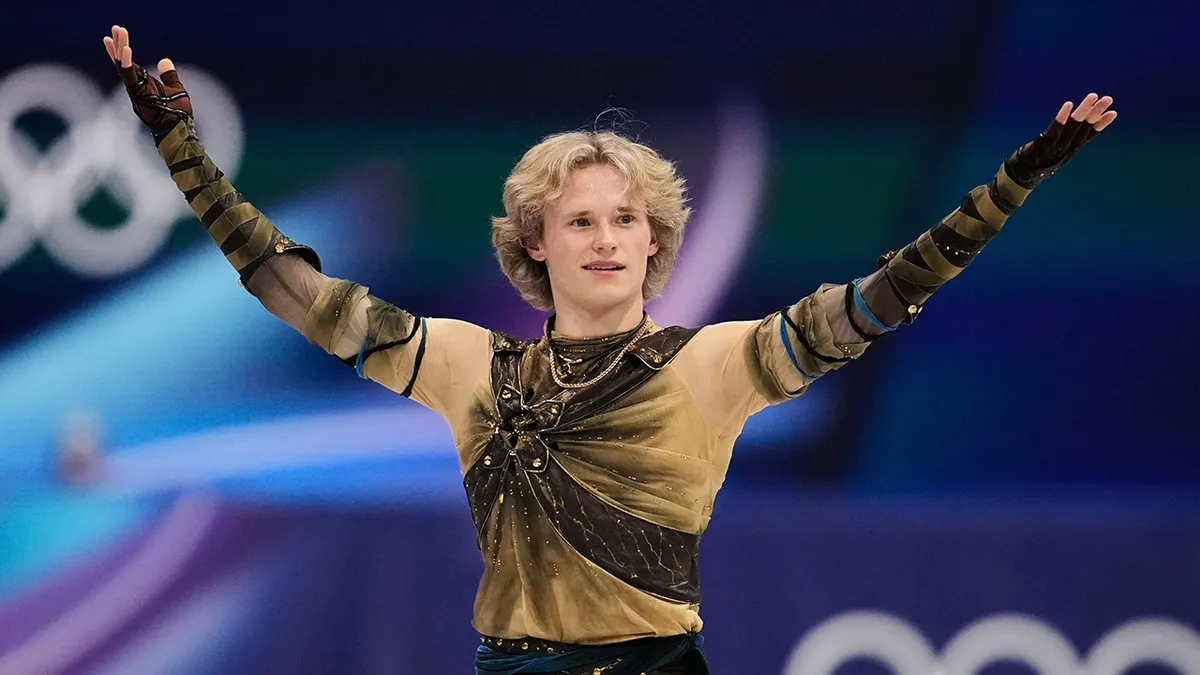
Just over a week after his Olympic gold dream slipped away, Ilia Malinin returned to the ice under entirely different circumstances. There were no rankings to chase, no judges’ panels looming over every move, and no scoreboard waiting to define his worth. This time, he stepped into the spotlight for the exhibition gala — a stage meant not for competition, but for expression.
The atmosphere felt noticeably calmer the moment he appeared. Without the tension that had surrounded his Olympic program, Malinin carried himself differently. His posture was relaxed, his face composed, and his movements held a quiet confidence that hadn’t fully surfaced during the high-stakes event days earlier.
From the first glide, commentators sensed the shift. His skating looked less like an attempt to prove something and more like a statement of identity. The edges were clean and controlled, and every transition flowed with a natural ease that seemed to reflect a young athlete finally skating for himself rather than for a result.
The jumps, which had defined his reputation as the sport’s “Quad God,” were still present. Each takeoff was sharp, each landing secure, executed with a steadiness that suggested not just physical recovery, but emotional grounding as well. Yet they didn’t feel like the centerpiece this time — they felt like part of a larger story.
What lingered most was his composure. There was no visible urgency, no hint of frustration, no trace of the pressure that had weighed on him during the Olympic event. Instead, he skated with a maturity that many analysts described as revealing a deeper side of his artistry.
As the program unfolded, it became clear that this performance wasn’t about redemption in the traditional sense. It wasn’t a fight to reclaim status or silence critics. It felt more like acceptance — a quiet acknowledgment that one competition does not define an athlete’s legacy.
The crowd responded differently as well. The applause wasn’t explosive in the way it often is after a record-breaking jump or a medal-winning routine. It was warmer, more sustained, carrying an undertone of empathy and admiration that went beyond sport.
But one of the most emotional moments happened away from the center of the broadcast. In the stands, just beyond the main camera’s focus, Malinin’s mother watched as her son completed his program. A spectator’s phone captured what the official feed did not — tears streaming down her face as she witnessed his calm, steady return to the ice.
That reaction added a deeply human dimension to the performance. It reminded viewers that behind every Olympic storyline lies a family absorbing every high and low alongside the athlete, often experiencing the emotional weight even more intensely.
When Malinin finished his final pose, he didn’t celebrate with dramatic gestures. He simply allowed himself a small, calm acknowledgment of the moment — a quiet nod that suggested understanding rather than triumph. In the end, he may not have left the Olympics with individual gold, but that gala performance revealed something arguably more enduring: resilience, growth, and the strength to skate forward without needing a medal to define him.