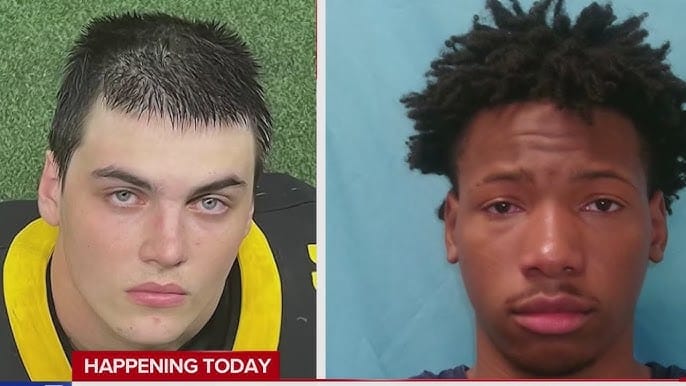
As the murder trial of Karmelo Anthony moves toward jury deliberations, legal observers are closely analyzing a decision that could prove critical to the outcome of the case.
From the beginning, many assumed the defense would focus almost entirely on self-defense. After all, Anthony has never denied that he stabbed Austin Metcalf. The central question has always been whether jurors believe he was legally justified in doing so.
But some legal analysts now believe the defense may have been laying the groundwork for a different argument from the very start.
Instead of asking jurors to fully embrace a traditional self-defense claim, some experts suggest the defense could be trying to create reasonable doubt about Anthony’s intent, potentially encouraging jurors to consider a lesser offense rather than a murder conviction.
The theory gained traction after observers revisited portions of the defense’s opening statements and compared them to the evidence ultimately presented during the trial.
Several analysts noted that the defense spent considerable time discussing Anthony’s fear, age, size, and perception of the situation, but presented relatively little evidence directly supporting a complete self-defense acquittal.
That distinction matters.
A successful self-defense claim generally requires jurors to conclude that the use of deadly force was legally justified under the circumstances. If jurors reject that argument, the defense could still hope they view the incident as something less than intentional murder.
Some legal commentators believe that possibility may explain why Anthony never took the witness stand.
In many self-defense cases, defendants testify to explain exactly what they feared and why they believed force was necessary. By choosing not to testify, the defense avoided a potentially difficult cross-examination but also left jurors without hearing Anthony’s personal explanation of the confrontation.
That decision has become one of the most debated aspects of the trial.
Supporters of the strategy argue that testifying may have exposed Anthony to damaging questioning from prosecutors. Critics argue that a self-defense claim is often harder to prove when the defendant never personally explains his state of mind.
Another factor drawing attention is the defense’s apparent focus on circumstances surrounding the confrontation rather than aggressively disputing the physical evidence itself.
The stabbing is not in dispute.
The key legal battle centers on intent, justification, and whether Anthony’s actions meet the legal standards for murder, self-defense, or a lesser offense.
If the defense is indeed shifting its focus toward reducing the severity of any potential conviction, some experts warn that it could be a dangerous balancing act.
Jurors may view the strategy as an acknowledgment that a full self-defense acquittal is unlikely. Others may see it as a practical attempt to avoid the harshest possible outcome.
Ultimately, no one outside the jury room knows exactly how the defense’s strategy will be received.
What is clear is that the case has now reached its most critical stage.
The evidence has been presented.
The witnesses have testified.
Anthony has chosen not to speak.
And twelve jurors must now decide whether the defense’s approach creates enough doubt to prevent a murder conviction—or whether the prosecution has proven its case beyond a reasonable doubt. ⚖️💔