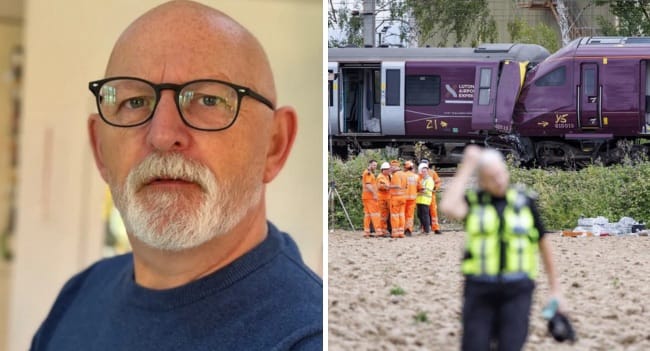
An interim investigation has revealed the first clear sequence of events leading up to the devastating train collision near Bedford, including the moment one train passed a red signal shortly before impact.
The crash happened at about 5:15 p.m. on June 19, 2026, near Elstow, south of Bedford, when a London-bound East Midlands Railway service collided with the rear of another stationary EMR train.
The driver who died in the collision has been named as 60-year-old Shaun Burton. He was driving the Corby-to-London St Pancras service when it struck the stationary Nottingham-to-London St Pancras train.
According to the Rail Accident Investigation Branch, the stationary Nottingham train had stopped after a fault caused its Automatic Warning System to trigger an automatic brake application. That stop caused the signal behind it to show red for approaching trains.
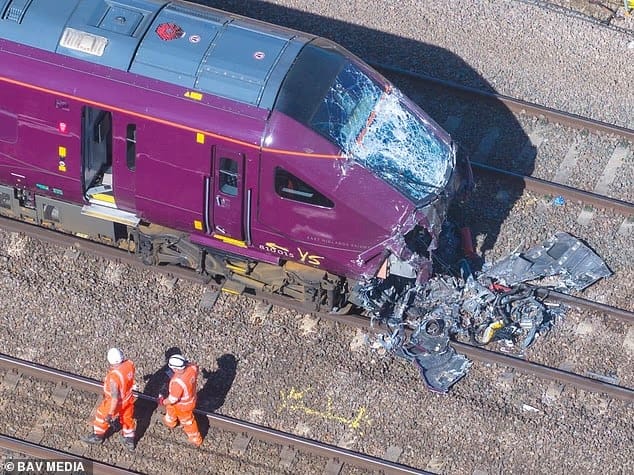
The interim report says Burton’s train then approached that signal and passed it while it was showing red. RAIB said forward-facing CCTV showed the signal displaying a red aspect as the train approached and went past it.
Investigators stressed that they still do not know exactly what warning Burton received inside the cab. The train’s onboard data is still being analysed, meaning officials have not yet said whether the Automatic Warning System alerted him correctly or how he responded.
One of the most important details now known comes from the train’s black box data. In the final nine seconds before the crash, Burton applied the brakes and slowed the train from about 76mph to 49mph before impact.
That final braking sequence has become a central focus of the investigation. It shows the train was slowing before the collision, but investigators must still determine why the braking happened so late and what information was available to the driver at that moment.
The RAIB also said Burton’s train had passed two yellow signals before reaching the red signal. Those earlier warnings are now part of the wider investigation into the approach to the stopped train.

The collision caused widespread injuries. Reports say 162 people were injured, with 102 requiring hospital treatment, while several remained in critical condition after the crash.
The investigation is also looking at whether other safety systems could have changed the outcome. The Guardian reported that the section of track had Automatic Warning System equipment but did not have the more advanced Train Protection and Warning System installed at that signal.
That detail has already raised wider questions about rail safety, because TPWS can automatically apply brakes in certain dangerous situations. Investigators have not yet reached final conclusions, but the issue is expected to be examined closely.
Recovery work has also been difficult. One of the trains partially derailed, and specialist crane equipment has been used to lift and remove the damaged vehicles from the tracks.
Network Rail and East Midlands Railway warned passengers that disruption through Bedford could continue for days while recovery, repairs, and safety checks take place.
Transport Secretary Heidi Alexander said investigators must be allowed to complete their work fully, adding that the railway remains one of the safest in the world but that no stone would be left unturned in understanding what happened.
For now, the interim report has answered one major question while opening several more. The train passed a red signal, the driver braked in the final seconds, and the full investigation will now determine why those final moments unfolded the way they did.