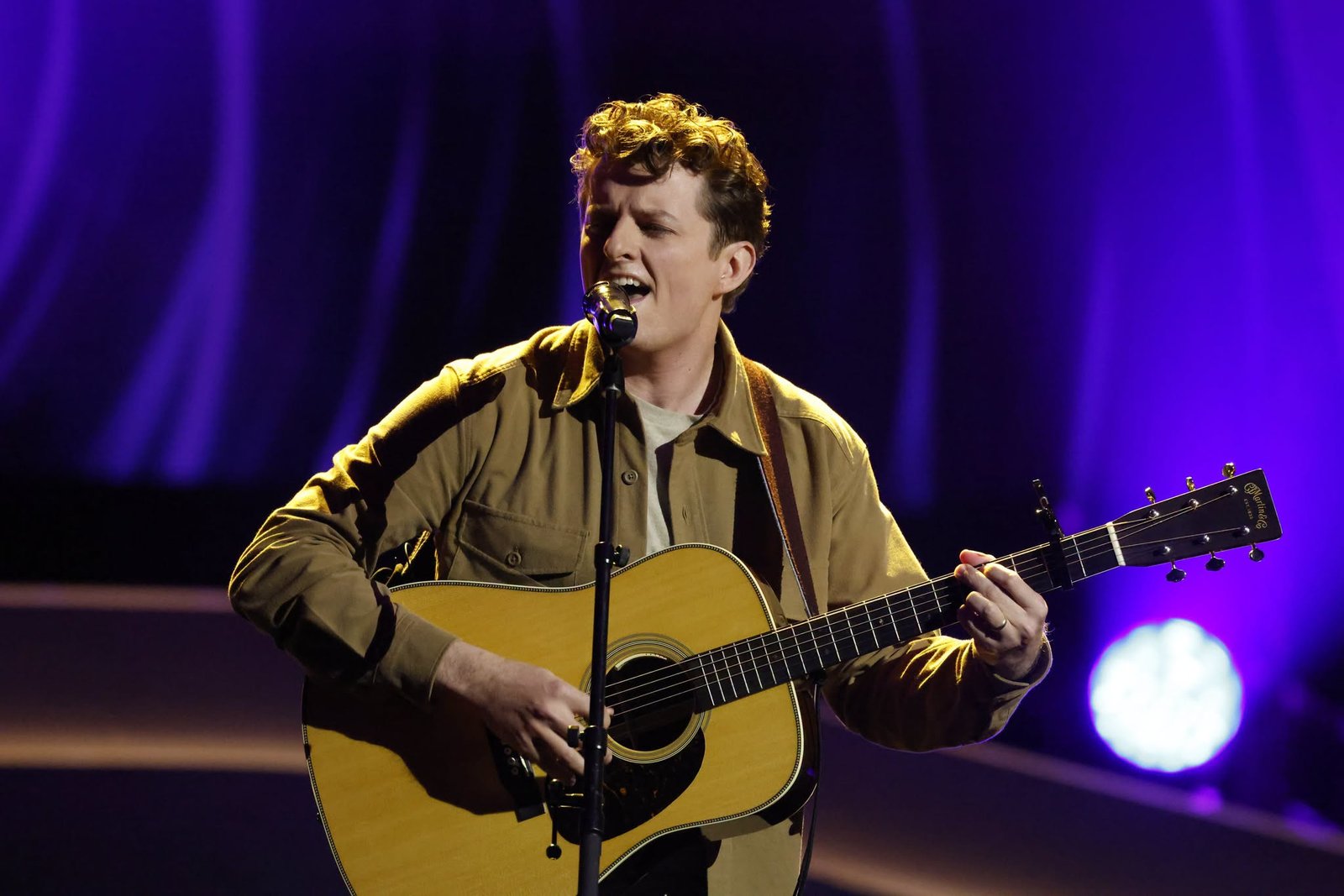
Luke Curran needed only the opening notes of his The Voice Season 30 Blind Audition to prove that he had something different. The 31-year-old singer from Sarasota, Florida, walked onto the stage with his acoustic guitar and began performing Jim Croce’s “Operator (That’s Not the Way It Feels).” Almost immediately, Riley Green recognized the distinctive, weathered quality in Luke’s voice and turned his chair. Adam Levine wasn’t far behind, setting up a two-coach battle for one of the night’s most authentic singer-songwriters.
Luke’s song choice was an important part of what made the audition work. Rather than selecting a modern pop hit built around huge high notes, he reached back to Jim Croce’s 1972 storytelling classic. “Operator” requires a singer to communicate the story naturally, and Luke’s folk-influenced delivery fit that approach perfectly. His slightly raspy tone, relaxed phrasing and acoustic guitar playing made the performance feel more like an intimate singer-songwriter set than a traditional television competition audition.
Riley was the first coach to react, and it happened extraordinarily quickly. Reporting on the audition described his chair turn as almost immediate, while Riley himself explained afterward that it only took him a couple of notes to know there was something in Luke’s voice that he wanted on his team. That distinction matters: it wasn’t literally a single note, but Luke barely had time to settle into the song before Riley had already made his decision.
Adam soon pressed his button as well. With both coaches now facing the stage, Luke continued performing without changing the understated style that had attracted them in the first place. There were no desperate attempts to manufacture a huge television moment. He remained behind his guitar, let the lyrics carry the song and trusted the natural texture of his voice — an approach that ultimately became one of the strongest parts of the audition.
Adam immediately praised both Luke’s voice and his decision to perform a Jim Croce song. That reaction wasn’t surprising considering Adam has often been drawn to contestants who arrive with a clear musical identity rather than simply displaying vocal range. Luke sounded like someone who already knew what kind of artist he wanted to be, combining folk, Americana and classic-rock influences instead of changing his style to fit what he thought The Voice coaches might want.
Riley’s pitch focused heavily on Luke’s storytelling ability. As a country singer whose own music depends on narrative songwriting, Riley appeared to immediately understand why Luke’s performance worked. He had heard the same thing that made “Operator” such an effective song choice: Luke wasn’t merely singing notes correctly — he was telling a story and allowing his voice to sound lived-in rather than overly polished.
That storytelling instinct comes directly from the kind of music Luke has been making away from The Voice. Luke describes himself as a Boston-based Americana singer-songwriter and multi-instrumentalist whose music draws from his upbringing around Northern Michigan, Florida’s Gulf Coast and Boston’s folk scene. His official biography describes a musical background filled with campfire harmonies, back-porch playing and roots music — influences that were easy to hear during his Blind Audition.
Luke is also more musically trained than his easygoing performance might initially suggest. He is a classically trained pianist and attended the Frost School of Music at the University of Miami. Although guitar has become a major part of his singer-songwriter identity, he plays multiple instruments, giving him a deeper musical foundation than viewers could see during a few minutes on the Voice stage.
His path toward that stage was not completely straightforward. Luke spent years playing music but also stepped away from pursuing it seriously for a period of time. He eventually returned with renewed focus, releasing his debut single “Leaving Home” in late 2024 before following it with his five-song Hymns EP in April 2025. That return to music gradually led to live performances and a growing presence within the Boston roots scene.
Just days before Season 30 premiered, Luke released another original song, “State Lines,” continuing to establish himself as a songwriter instead of relying entirely on covers. His original music carries many of the same characteristics that attracted Riley and Adam during the Blind Audition: acoustic instrumentation, Americana influences and an emphasis on lyrics and storytelling.
All of that made the coach battle particularly interesting. Riley appeared, on paper, to be an almost perfect match. Luke’s Americana and roots influences overlap naturally with Riley’s country background, and Riley had been the first person to recognize his talent. Being told that a coach knew within only a couple of notes that he wanted you could have been a powerful reason to choose Team Riley.
But Adam had another advantage that neither coach knew about when Luke first walked onto the stage.
Luke revealed that he had been watching The Voice since the beginning. He described himself as a “day one” fan of the show, which meant Adam wasn’t simply another coach competing for him. Adam represented the original era of The Voice that Luke had watched long before imagining himself standing on the stage. Once that history became clear, Riley suddenly faced an obstacle that had nothing to do with genre or coaching strategy.
When the time finally came to choose, Luke followed that longtime connection and selected Adam Levine, officially becoming a member of Team Adam. It was a difficult result for Riley after being the first coach to turn and making such a natural musical connection with him, but Luke’s decision made much more sense once viewers learned how long he had followed the show.
The result also gave Adam another artist with a very distinctive identity. Luke doesn’t sound like a conventional pop powerhouse, and that may become one of his biggest advantages once the competition moves into the Battles. His raspy Americana tone, strong guitar playing and ability to communicate a lyric give Adam an artist who can potentially transform songs rather than simply reproduce them.
Luke Curran’s audition ultimately proved that a Voice performance doesn’t require four chair turns or enormous vocal runs to become memorable. Riley Green heard something special almost immediately. Adam Levine quickly heard it too. But after two coaches fought for the singer with the raspy, storytelling voice, the biggest revelation came when Luke explained that he had watched The Voice from the very beginning. Riley may have been the first coach to recognize Luke’s talent that night, but Luke’s connection to Adam had been developing for years — and when the decision finally arrived, the longtime fan got the coach he had been watching since day one.