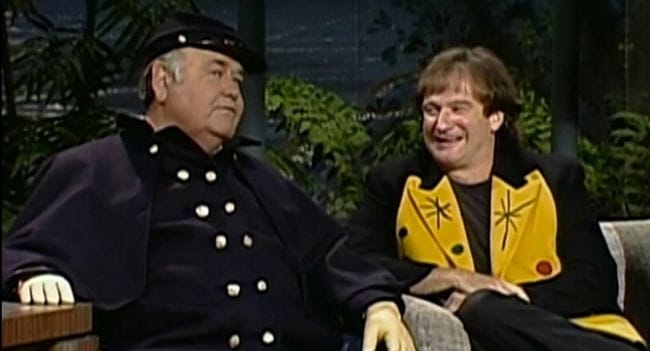
Robin Williams didn’t walk into Jonathan Winters’ 60 Minutes interview — he detonated it. What began as a measured, thoughtful conversation instantly transformed the moment Robin appeared, as if a live wire had been dropped into the room. The shift was immediate and unmistakable. Serious television gave way to something faster, freer, and utterly uncontrollable.
Jonathan Winters, already a legend in his own right, greeted the moment with that familiar mix of mischief and wisdom. His humor had always come from odd angles and quiet absurdity. Robin, by contrast, arrived at full velocity — voices, characters, rapid-fire riffs tumbling out faster than anyone could process. Together, they formed a perfect storm.
The laughter wasn’t polite or planned. It was reflexive. Crew members struggled to keep straight faces. The structure of the interview bent under the weight of two comic minds feeding off one another in real time. Questions dissolved. Answers became launching pads. The moment stopped being about journalism and became about instinct.
What made the exchange unforgettable wasn’t just the volume or speed — it was the respect. Robin idolized Winters, and Winters clearly delighted in Robin’s boundless energy. You could see it in their glances, in the way one joke invited another, in how neither tried to dominate the room. They weren’t performing at each other. They were playing with each other.
This wasn’t a rehearsed bit or a manufactured TV moment. It was comedy happening exactly as it should — unscripted, unpredictable, and alive. The camera simply tried to keep up. There was no reset button, no attempt to regain control, and that’s precisely why it worked.
Decades later, fans still return to the clip not because it’s flashy, but because it’s honest. It captures a rare collision between two generations of comedy — one passing the torch, the other burning with everything it had. You don’t watch it to analyze jokes. You watch it to feel the joy of minds in motion.
It isn’t just an interview. It’s a reminder of what happens when brilliance meets brilliance and no one tells it to slow down. In those few chaotic minutes, television didn’t document comedy history — it became it.